Softgels are one of the most popular formats in the supplement aisle. Fish oil, vitamin D3, vitamin E, evening primrose oil, krill oil and plant oils such as flaxseed or black seed oil all sit naturally inside a soft, seamless shell that is easy to swallow and protects the fill from air. That popularity hides a fact many new brands learn late: softgels are harder to make well than tablets or hard capsules. Encapsulation, drying and packing all affect whether a product reaches the customer looking and performing the way it left the factory.
If you are a brand owner or an importer looking for a softgel capsules manufacturer in India or anywhere else, these ten checks will help you compare suppliers on more than price.
1. Which shell does the product need?
Most softgel shells are made from gelatin, which can come from bovine, porcine or fish sources. The source matters for your buyers. Products for Halal markets need a Halal-certified gelatin, usually bovine or fish, and the certificate should cover the shell as well as the fill. Vegetarian and vegan brands need a plant-based shell, typically made from modified starch and carrageenan. Plant shells behave differently in production and storage, so ask whether the manufacturer runs them regularly or only on request.
2. What type of fill is it – and can the line handle it?
A clear oil such as fish oil or vitamin E is the simplest fill. Suspensions, where a powder is dispersed in oil, and thicker pastes are harder: the particles must stay evenly spread and must not wear down the encapsulation dies. Ask what fill types the manufacturer handles every week and request examples of similar products already made.
3. How are marine and plant oils protected from oxidation?
Oils that contain unsaturated fats can oxidise, which affects taste, smell and shelf life. A careful softgel manufacturer controls this from the raw material onward: by checking incoming oil, handling it under nitrogen where needed, and keeping storage tanks cool. For fish, krill and algae oils, ask which oxidation limits are written into the specification. Common measures are peroxide value, anisidine value and total oxidation (TOTOX). Ask whether these are tested on every batch of finished capsules as well as on the raw oil.
4. How is fill weight checked?
Each softgel should hold the declared amount, batch after batch. Ask how often fill weight is checked during encapsulation, what tolerance is allowed and what happens to capsules outside it. A manufacturer with good control can show you the in-process records for a recent batch, with any personal or client details removed.
5. How are seams, leakers and hardness controlled?
A softgel is formed from two ribbons of shell sealed around the fill. A weak seam leads to leaking capsules that stick together and stain the pack. Ask how seam thickness is checked, how leakers are found and removed, and how capsule hardness is measured after drying. Drying matters more than many buyers realise: capsules that are dried too little stay soft and sticky, while over-dried capsules become brittle.
6. What size and shape suit your dose?
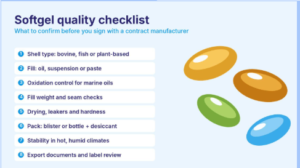
Softgels come in oval, oblong and round shapes and in many sizes. The right choice depends on the dose per capsule, the fill’s density and how easy the capsule is to swallow. Fewer, larger capsules can lower cost, but very large softgels put some customers off. Ask the manufacturer to suggest two options and explain the effect on capsules per day and cost per pack.
7. Which pack protects the product best?
Softgels react to heat and humidity. Blister packs, especially aluminium-aluminium blisters, give each capsule its own protection, which helps in hot climates. Bottles are popular and cost less per capsule, but the closure, the fill level and any desiccant must suit softgels. Too strong a desiccant can over-dry the shell. Ask for a recommendation for your market and the reason behind it.
8. Is there stability data for your market’s climate?
Shelf life should be supported by stability data for the actual formula, shell and pack. If you sell in the Gulf, India, Africa or South-East Asia, ask whether the data covers hot and humid conditions, such as the 30 °C / 75% relative humidity conditions used for these climate zones. A study run only in mild conditions does not tell you how capsules behave in a warehouse in Dubai or Lagos.
9. Can the manufacturer supply your export documents?
Registration and customs teams usually ask for a product specification, a certificate of analysis for each batch, stability data, a Certificate of Free Sale and a Certificate of Origin, plus quality certificates such as GMP, ISO 22000, HACCP, Halal or Kosher. Ask for samples of each document before you sign. If they cannot be shown now, they are unlikely to arrive on time later.
10. Who checks the label, and against which rules?
Label requirements differ between India, the Gulf, the EU, the UK and the USA, from the way ingredients are listed to the claims allowed. The brand owner is responsible for the label, but an experienced manufacturer will often spot problems early. Agree who reviews the artwork, against which market’s rules, and that nothing is printed until you approve it.
Putting it together
These questions are routine for an established softgel capsule manufacturer, and the answers should come quickly and in writing. They also make quotations comparable: a lower price per thousand capsules means little if oxidation limits are loose, drying is rushed or no stability data exists for your climate.
Three habits help: write a one-page brief (fill, strength per capsule, shell type, capsule size, pack, quantity and target market); request the same documents from every supplier; and plan time for samples made on the production line, not just in the laboratory. Brands that do this at the start spend far less time fixing problems after launch.
About the author
INFY LIFE SCIENCE is a nutraceutical and health supplement manufacturer near Ahmedabad, India. The company makes private label and contract products for brands in 15+ countries, including gelatin and vegetarian softgel capsules, tablets, capsules, gummies and powders.
